Class Journal - Math 2401 (10925)
What I hear, I forget; what I
see, I remember; what I do, I understand.
- Kung Fu Tzu (Confucius)
One learns the thing by doing the
thing; for though you think you know it,
You have no certainty until you
try. - Sophocles
|
Session |
Date |
Read
& Study Section |
Discussion
Topics |
Practice
HW
Problems |
Other
Info |
|
30 |
12 - 15 |
|
The
Final Exam will be on Tuesday,
December 15, from 10 a.m. - 12:30 p.m., and it will be comprehensive. Bring
a pencil and a scientific calculator to the exam (no cell phone calculators
allowed; no sharing of calculators allowed). WebAssign homework must
be completed by Tuesday, December 8. You
should review the three semester tests to help prepare for the exam, as well
as your notes and examples from the book. You may also get additional help for the course in the
CCLC (S735), for a limited time, and from me (S707). |
|
|
|
29 |
12 – 3 |
5.5 3.6 |
More examples from sections 5.5, 3.6 and 4.7 were done in class. In section 4.7, the following rule (theorem) is sometimes helpful: If f(x) is a continuous function on an interval [a,b], then f(x) has an absolute maximum and an absolute minimum on the interval, and these optimal values occur at a critical point or at an endpoint. In practice this means that: 1st we find the critical numbers where f’(x) equals zero or is undefined; 2nd we compute f(x) at the critical numbers and at the endpoints; 3rd the largest value of f(x) in step 2 is the absolute maximum value of f(x) and the smallest value of f(x) in step 2 is the absolute minimum value of f(x), on the interval. |
See below. |
The graphs of equations in x and y may have “fanciful shapes” – use the plot function that is freely available at Wolfram Alpha to graph some of the equations in the section 3.6 exercises. |
|
28 |
12 - 1 |
5.5 3.6 |
Section 5.5 (1) By the general power rule/chain rule, the derivative of [f(x)]n is n[f(x)]n-1 ∙ f′(x). (2) By definition, if y=f(x), then the differential dy= f′(x)dx. These two properties are the basis for the substitution method of integration. See page 334. Typically, the substitution method is used when the integrand involves a function inside of a function. Then u is chosen to equal the inside function. Study examples 1 – 7 on pages 334 – 337. Section 3.6 Let’s assume y=f(x), that is, y is a function of x. Then (1) d/dx [yn ]= n[y]n-1 ∙ y′ by the chain rule; and (2) d/dx [xy]= x ∙ y′ + y ∙ x′ = x ∙y′ + y ∙ 1 = xy′ + y by the product rule. Calculations like these are used in the method of implicit differentiation. In this method, we begin with an equation in x and y, and we assume that y is implicitly a function of x. To find dy/dx=y′: 1st, we differentiate each side of the equation with respect to x; 2nd, we solve the resulting equation for y′. Study examples 1 – 4 on pages 165 – 168. |
Section 5.5 # 1 – 21 odd, 27, 29, 35, 37, 39 Section 3.6 # 3 – 19 odd, 25 |
All Web Assign homework assignments for the semester are now open with a due date of Tuesday, December 8. |
|
27 |
11 - 24 |
|
Test 3 (2.5 Continuous functions; 4.1 Maximum/Minimum Values; 4.3 How Derivatives Affect the Shape of a Graph; 4.7 Optimization Problems; 4.8 Newton’s Method, 4.9 Antiderivatives; 5.1/5.2 Areas and The Definite Integral; 5.3 Fundamental Theorem of Calculus; 5.4 Indefinite Integrals) Bring a pencil and a calculator; no cell phone calculators are allowed and no sharing of calculators is allowed. All WebAssign homework must be
completed by Monday, November 23. |
||
|
26 |
11 - 19 |
5.4 |
Section 5.4 It
is important that a definite integral
You should study the table of indefinite integrals on page 325. In an application problem, the units of measure on In exercise 45 on page 330, y is not a function of x since there is not just one value of y for each value of x. However, if you turn your head and think of y as the independent variable and x as the dependent variable, then x is a function of y. The area of the shaded region can then be found by integrating with respect to y and by using the y-intercepts as the limits of integration. Read ahead in section 5.5: in some problems, a complex integral can be rewritten as a simpler integral by making a change of variable. This method of integration is often called the u-substitution method. |
See below. |
|
|
25 |
11 - 17 |
5.3 5.4 |
Section 5.3
Because of part II of the Fundamental Theorem of Calculus, we now have a rule
to calculate a definite integral by hand:
where F(x) is any antiderivative of f(x). So now we must focus on rules for finding antiderivatives. Section 5.4 The
notation So to check an indefinite integral, you differentiate the answer! See exercise 1 on page 329. Note in particular that when C=0, then There is a table of indefinite integrals on page 325. Class activity 11
was done during class today. |
Section 5.4 # 1, 2, 3, 5 – 11 odd, 17 – 39 odd, 45, 46, 47, 49 |
|
|
24 |
11 - 12 |
5.1/5.2 5.3 |
Section 5.1/5.2
The area under a continuous curve y=f(x) from x=a to
x=b can be approximated by using rectangles. The sum of the areas is called a
Riemann sum after the German
mathematician Bernhard Riemann. The more rectangles used, the better the
approximation. It can be shown that the limit of these sums as the number of
rectangles n tends to infinity exists when f(x) is a continuous function.
This limit is called the definite
integral of f(x) from x=a to x=b and it is denoted by Note the geometric meaning of a definite integral on page 301: it gives the net area of the region between the curve and the x-axis. See figure 4. Definite integrals have many mathematical properties; see pages 307-309. Section 5.3 The
Fundamental Theorem of Calculus
(Part I and II) relates integrals and derivatives. See pages 315 and 318.
Part II states that |
Section 5.3 # 1, 2, 3, 7, 9, 19-33 odd |
|
|
23 |
11 - 10 |
4.9 5.1/5.2 |
Section 4.9 There is a summary table of antidifferentiation formulas and properties on page 276 – you should study this table. Note that an equation which involves the derivatives of a function is called a differential equation; see page 276. The most general antiderivative of f (x) is F(x)+C where C is an arbitrary constant and F ′(x)= f (x). However some extra conditions may be given so that only a particular constant satisfies these conditions; these are sometimes called “initial conditions.” Carefully study examples 3 and 4 on page 276-277. Section 5.1/5.2
We now want to learn how to calculate
the area bounded above by a
curve y=f(x), below by the x-axis, on the left by x=a, and on the right by
x=b. See figure 1 on page 289. Rectangles
may be used to approximate this area. For n rectangles: each has width equal
to (b-a)/n; the height of a rectangle equals the height of the curve at the
right endpoint, that is, height=y= f(right
endpoint); then we sum the areas of the n rectangles. The example done in class,
partly by hand and partly by computer, showed that the greater the number of
rectangles used, then the better the approximation of the area. This is a
critical observation. |
See below and Section 5.1 # 1- 4, 16 Section 5.2 # 5 – 8, 33, 34 |
|
|
22 |
11 - 5 |
4.8 4.9 |
Section 4.3 Problem 12 was discussed. Section 4.8 Newton’s method is a recursive numerical method that is used to estimate a root of an equation. Study pages 269 and 270. Note that Newton’s method may work very slowly or may not work at all – see figure 4 on page 270. The initial approximation x1 is very important in this method. It was demonstrated in class that EXCEL may be very useful in carrying out Newton’s method in a problem. Section 4.9 A function F is called an antiderivative of a function f on an interval I if F ′(x) = f(x) for all x in I. Antidifferentiation is the inverse operation of differentiation: we start with f(x) and want to find a function F(x) whose derivative equals f(x). However, antiderivatives are not unique: F(x)=(x3+1) and F(x)=(x3-5) are both antiderivatives of f(x)= 3x2. The theorem on page 275 states that if F is a particular antiderivative of f, then the most general antiderivative of f is F(x)+C where C is an arbitrary constant. Study section 4.9. Class activity 10
was done during class today. |
Section 4.8 # 1, 5-23 odd, 27, 29 Section 4.9 # 1 – 15 odd, 19, 21 – 39 odd, 51, 53 |
Here is the link to one of the many available applets on Newton’s Method that is available on the internet. |
|
21 |
11 – 3 |
4.1 4.3 4.7 |
Section 4.1 A critical number of a function f(x) is a number c in the domain of the function such that f ‘(c)=0 or f ‘(c) does not exist. See page 208. To calculate critical numbers: you must correctly calculate the derivative f ‘(x) and then you must correctly solve the equation f ‘(x)=0. Study example 7 on page 208. Section 4.3 At an inflection point, f “(x)=0 or f “(x) does not exist. So to calculate the location of an inflection point: first, calculate f “(x); second, solve the equation f “(x)=0 to get the possible inflection points; and third, check the sign of f “(x) on each side of a possible inflection point to determine if the concavity changes. Study example 6 on page 225. Note that f ‘(x) is increasing when f(x) is concave up and f ‘(x) is decreasing when f(x) is concave down. Therefore when f(x) changes from concave up to concave down, the inflection point is a local maximum on the graph of f ‘(x) or a point of greatest slope compared to nearby points. Similarly, when f(x) changes from concave down to concave up, then the inflection point is a local minimum on the graph of f ‘(x) or a point of smallest slope compared to nearby points. This is important in application problems like the inflation example discussed in class today. Section 4.7 Problem solving tips in optimization problems: (1) read the problem for understanding; (2) draw a diagram; (3) introduce math notation; (4) write an equation/formula for the quantity that is to be maximized or minimized; (5) use calculus methods (derivatives, critical numbers, etc.) to solve the problem. See pages 256-257. Carefully study the examples in section 4.7. |
See below. |
The UBM program provides undergraduate research opportunities at UHD: click here for more information. |
|
20 |
10 - 29 |
4.3 4.7 |
Section 4.3 What does the second derivative f "(x) tell us about the shape of the graph of f(x)? The graph of the function f(x) is concave up on an interval if (1) f "(x) is positive; or if (2) f '(x) is increasing; or if (3) the graph of f(x) lies above all of its tangent lines in the interval. The graph of the function f(x) is concave down on an interval if (1) f "(x) is negative; or if (2) f '(x) is decreasing; or if (3) the graph of f(x) lies below all of its tangent lines in the interval. See pages 223 and 224. A point P on a continuous curve y=f(x) is an inflection point if the curve changes concavity at the point. See figure 9 on page 225. It can be shown that f "(x) equals 0 or it is undefined at an inflection point. In application problems it is important to note that at an inflection point a function is changing at the fastest rate or at the slowest rate compared to other nearby points. An inflection point may be a point of diminishing returns. Section 4.7 In optimization problems, we are trying to find the extreme values of a function in application settings such as: maximizing area, volume or profit, or minimizing distance, time or cost. Carefully study the examples in this section. Class activity 9 was done during class today. |
See below and Section 4.7 # 1 – 5 odd, 9, 10, 11, 12, 13, 14, 18, 23, 24, 26, 30, 47, 57 |
Click here for an
applet that graphs a function f(x) and the line tangent to the graph of f(x)
for a given x-value. Have fun! |
|
19 |
10 - 27 |
2.5 4.1 4.3 |
Section 2.5 By theorem 4 on page 100, if f and g are continuous at x=a, then so are f+g, f-g, fg, f/g if the denominator is not zero, and cf for any real number c. Therefore f(x)=x2+sin(x) is continuous for all real numbers since it is the sum of a polynomial function and a trig function. The Intermediate Value Theorem on page 104 gives the mathematical reason that we can draw the graph of a continuous function by plotting just a few points: it states that no y–values can be skipped as we move from one point to another point on the graph. An important application of the Intermediate Value Theorem is to help solve equations. Carefully study example 9 on page 104. Section 4.1 A function f has an absolute maximum at x=c if f(c) > f(x) for all x in the domain of f. The function f has a local maximum if f(c) > f(x) for all x near c. See page 205. There are similar descriptions for absolute minimum and local minimum. First Derivative Test For Local Extrema Part I: If f has a local maximum or a local minimum at x=c, then f’(c)=0 or f’(c) does not exist [such a number x=c is called a critical number of f]. Therefore to find the local extrema, we will first solve for the x-values so that f’(c)=0 or f’(c) does not exist. Section 4.3 What does the first derivative f’(x) tell us about the shape of the graph of f(x)? First Derivative Test For Increasing/Decreasing: If f’(x)>0 on an interval, then f(x) is increasing on the interval; if f’(x)<0 on the interval, then f(x) is decreasing on the interval. See page 221. First Derivative Test For Local Extrema Part II: Suppose f’(c)=0 or f’(c) does not exist and f is a continuous function. If f’(x) changes from positive to negative at x=c, then f has a local maximum at x=c; if f’(x) changes from negative to positive at x=c, then f has a local minimum at x=c; if f’(x) does not change sign at x=c, then f has no local extrema at x=c. Carefully study example 2 on page 222 to see how these rules are used. |
See below and Section 4.1 # 3, 5, 7, 9 Section 4.3 # 1, 3, 5, 7, 9, 11, 13, 29, 31, 33, 35, 39, 41 |
|
|
18 |
10 - 22 |
|
Test 2 (3.1
Derivatives and rates of change; 3.2 The derivative as a function; 3.3
Differentiation formulas; 3.4 Derivatives of trigonometric functions; 3.5 The
chain rule) Bring a pencil and a calculator; no cell phone calculators allowed and no sharing of calculators is allowed. All WebAssign homework must be
completed by Wednesday, October 21. |
||
|
17 |
10 – 20 |
3.5 2.5 |
Section 3.5 When y is a function of u, that is y=f(u), and u is a function of x, that is u=g(x), then this is a composition of functions since by substitution y=f(u)=f(g(x)). In this case, the chain rule can be written by using Leibniz notation as: dy/dx = dy/du ∙ du/dx. This is explained on page 156. The chain rule can be used more than once in the same problem. Study example 7 on page 160. Several problems were discussed in class from Test 2 topics. Section 2.5
When We say the function is continuous on an interval of numbers if the function is continuous at each number in the interval. Intuitively, the graph of a continuous function is unbroken. Study example 1 on page 97. By theorems 7 and 8 on pages 102-103, the following functions are continuous at every number in their domain: polynomials, rational functions, root functions, trig functions, and composition of continuous functions. |
Section 2.5 # 1, 2, 3, 4, 47, 49, 51, 53 |
|
|
16 |
10 - 15 |
3.4 3.5 |
Section 3.4
Note that When the problem states “differentiate a given function f(x)”, it is important that you first classify the given formula as a sum, product, quotient, etc., and then choose the appropriate derivative rule to start with. For example, y=x2sin x is a product, and so you would first apply the product rule of derivatives. Then inside of the product rule, you will use the power rule and the rule for sin x. See example 1 on page 151. Section 3.5 In the composition of functions f(g(x)), the outside function is f(x) and the inside function g(x). The function h(x)=(3x-1)4 can be written as a composition with outside function f(x)=x4 and inside function g(x)=3x-1. The chain rule is used to differentiate a composition of functions. It states: [f(g(x))]' = f '(g(x))∙ g'(x). See the verbal description on page 157. A special case of the chain rule is the “function to a power rule”: {[f(x)]n}' = n{[f(x)]n-1}∙ f '(x). Study the examples in section 3.5. Class activity 8
was done during class today. |
Section 3.5 # 1 – 15 odd, 18, 20, 21, 28, 48, 61, 77 |
Click here for an applet that graphs a function f(x) and the line tangent to the graph of f(x) for a given x-value. Have fun! |
|
15 |
10 - 13 |
3.3 3.4 |
Section 3.3 Multiplication and division are inverses – do the product rule and quotient rule involve inverses? Decide for yourself by comparing the patterns in each rule shown below. Product rule: Quotient rule: Note that a summary table of shortcut derivative rules is given on page 144. Section 3.4 The unit circle has: center at the origin (0,0); radius equal to 1; circumference length equal to 2π; and equation x2+y2=1. The radian measure of an angle equals the length of the arc along the circumference of the unit circle that is obtained by rotating the positive part of the x-axis in a counter clockwise direction to get the angle if the angle is positive and rotating it in a clockwise direction to get the angle if the angle is negative. The point (x,y) on the circumference of the unit circle that corresponds to the angle θ can be used to define the trig functions: sin(θ)=y, cos(θ)=x, tan(θ)=y/x, csc(θ)=1/y=1/sin(θ), sec(θ)=1/x=1/cos(θ), and cot(θ)=x/y=1/tan(θ). Graphs of these trig functions are shown on page 2 of the Reference Pages at the beginning of the book. Note that the domains of the tangent, cosecant, secant and cotangent functions do not include any values that make the denominator equal zero. On page 149, the limit definition of f '(x) is used to
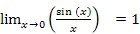
calculate the derivative of f(x)=sin(x). In these
calculations, it is necessary to make use of the following limit: The following rules for the derivatives of the sine, cosine and tangent functions are proven to be true: [sin(x)]'=cos(x), [cos(x)]'= -sin(x) and [tan(x)]'=1/[cos(x)]2=sec2(x). There is a summary table on page 152. |
See below. |
|
|
14 |
10 - 8 |
3.1 3.2 3.3 |
Section 3.1 The
limit definition f '(a) =
Section 3.2 Velocity is the rate of change of position with respect to time: if s(t) is the position of a particle at time t that is moving along a straight line then the velocity of the particle at time t is v(t) = s '(t). Acceleration is the rate of change of velocity with respect to time: so a(t) = v '(t) = (s '(t)) ' = s"(t), which is the second derivative of the position function. Therefore to calculate a second derivative, first calculate the first derivative, and then calculate the derivative of the first derivative. Study page 130. Section 3.3 There is a shortcut rule for the derivative of a product of differentiable functions called the Product Rule – see page 139. The verbal description of the product rule is on page 140. There is a shortcut rule for the derivative of a quotient of differentiable functions called the Quotient Rule – see page 140. The verbal description of the quotient rule is on page 141. Carefully study the examples in section 3.3. Class activity 7
was done during class today. |
See below and Section 3.4 # 1, 2, 5, 9, 10, 13, 23, 24, 35 |
|
|
13 |
10 - 6 |
3.2 3.3 |
Section 3.2 In many of our problems, we begin with a given function f(x). From this function, we can use the limit definition to derive a new function f '(x), the derivative of f, which gives the slope of the tangent line to f(x) at the point (x, f(x)). It is important to note that the domain of f '(x) may not equal the domain of f(x); in many problems, the domain of f '(x) is a smaller set than the domain of f (x). Study example 3 on page 125. Graph of f(x) versus graph of f '(x): (1) if the tangent line to the graph of f(x) is horizontal at x=a then the derivative f '(a)=0 and so x=a is an x-intercept of the graph of f '(x). (2) if the graph of f(x) has a sharp turning point at x=a, or it has a break at x=a, or it has a vertical tangent line at x=a, then f '(a) does not exist. Therefore, in these three cases, x=a is not in the domain of f '(x), and this means the graph of f '(x) will have a break at x=a. (3) if the graph of f(x) is rising on an interval of x-values, then the tangent line is rising and so it will have positive slope. Therefore, over this interval of x-values, the graph of f '(x) will be above the x-axis since the derivative f '(x) equals the slope of tangent line. (4) if the graph of f(x) is falling on an interval of x-values, then the tangent line is falling and so it will have negative slope. Therefore, over this interval of x-values, the graph of f '(x) will be below the x-axis since the derivative f '(x) equals the slope of tangent line. Study examples 1 and 2 on pages 124-125. In Leibniz notation, the derivative of y=f(x) is written as dy/dx which is read as “dee y dee x”. See page 126. Section 3.3 Several short-cut derivative rules can be proved to be true from the limit definition of the derivative: constant function rule – see page 135; constant multiple of a function rule – see page 137; sum/difference rule – see page 137-138; power rule – see pages 136 & 142. |
See below. Section 3.3 Differentiate the function # 1 , 2, 4, 5, 6, 9, 10, 13,
15, 21, 22, 32, 25, 26, 27, 31, 35, 36, 37, 41, 47, 49, 51, 57, 61, 63, 71 |
|
|
12 |
10 - 1 |
3.1 3.2 |
Section 3.1 Applications If s=f(t) is the position function of a particle that moves along a straight line, then f ‘(t) equals the rate of change of position with respect to time, which is also the velocity of the particle at time t. Study page 118. Note speed equals the absolute value of velocity. If C=f(x) is the cost to produce x yards of fabric, then f ‘(x) equals the rate of change of cost with respect to the production level, and this is also called the marginal cost in economics. Study example 6 on page 118. Section 3.2 The instantaneous rate of change of f(x), which is denoted by f ‘(x) is also called the derivative of f. Therefore, f
‘(x) = It is helpful to be able to draw the graph of f ‘(x) from the graph of f(x). Study example 1 on page 124. Class activity 6
was done during class today. |
See below and Section 3.2 # 1, 3, 17, 19, 23, 25, 33, 35 |
|
|
11 |
9 - 29 |
2.2 3.1 |
Section 2.2
When we say a function limit exists and we write In general, if f(x)=P(x)/Q(x) and as x approaches a the limit of the numerator P(x) is a finite nonzero number but the limit of the denominator Q(x) is zero, then the limit of f(x) as x approaches a does not exist. Study example 8 on page 72. Functions to which the Direct Substitution Property can be applied are said to be continuous at a; these will be studied more closely in section 2.5. Section 3.1 The
following are equivalent quantities: (1) the instantaneous rate of change of
f(x) at x=a; (2) the derivative of f(x) at x=a; (3) the slope of the tangent
line to f(x) at x=a; (4) |
Section 3.1 # 1, 3, 5, 7, 9, 12, 15, 16, 17, 43, 50 |
|
|
10 |
9 - 24 |
|
Test 1 All topics discussed since the beginning of the semester thru Thursday, September 17, including: Function properties, such as function notation, domain and range, turning points, increasing on an interval, decreasing on an interval, writing mathematical models; Average rate of change of a function from a graph and from a formula; Instantaneous rate of change of a function from a graph and from a table; Interpret values in the context of the problem Linear functions f(x)=mx+b have average rate of change of f(x) always equal to m, and instantaneous rate of change of f(x) always equal to m. Limit of a function, limit laws, direct substitution property. Make sure you work through the problem packets given below: Average Rate of Change, Tangent Lines, Approximate f '(a) Graphically and Numerically.) Bring a pencil and a calculator; no cell phone calculators allowed and no sharing of calculators is allowed. All WebAssign homework must be completed by Wednesday, September 23. |
||
|
9 |
9 - 22 |
2.2 3.1 |
Section 2.2 When Does a Function Limit Not Exist “The limit of f(x), as x approaches a, equals L” means that (1) L is a definite finite number; (2) if x is close to a but smaller than a then f(x) is close to L and if x is close to a but larger than a then f(x) is close to L. Example 4 on page 69 shows a function limit that does not exist because as x gets closer to a=0 the value of f(x) continuously oscillates between -1 and 1. Example 7 on page 71 shows a function limit that does not exist because as x gets closer to 2 but x is smaller than 2 then f(x) gets closer to 3 but as x gets closer to 2 but x is larger than 2 then f(x) gets closer to 1. Example 8 on page 72 shows a function limit that does not exist because as x gets closer to 0 then f(x) becomes larger and larger: we say f(x) diverges to infinity as x approaches 0. Section 3.1 The
definition of the tangent line to the curve y=f(x) at the point (x,y)=(a, f(a)) is the line
through this point with slope equal to
|
||
|
8 |
9 - 17 |
2.3 |
When Does f '(a)
Not Exist Sometimes when we zoom-in on the graph of a function at a particular
point, the graph will not appear to be a straight line or it will appear to
be a vertical line. When this happens, we will see that f '(a) does not
exist. Here are some cases when f '(a) does not exist: (1) the graph of f(x)
has a sharp turning point at x=a; (2) the graph of f(x) has a break or hole
at x=a; (3) the graph has a vertical tangent line at x=a. See page 129. Direct Substitution Property Cannot Be Used: If f(a) is not defined so that x=a is not in the domain of f(x) then the direct substitution property cannot be used. However, it is sometimes possible to use algebra to show that the formula for f(x) equals the formula for a different function g(x) for all x except x=a. In this case, if the limit for g(x) as x approaches a exists, then the limit for f(x) as x approaches a will also exist and have the same value. This is because the limit definition uses x values close to a but not equal to a. Examples 3, 5, and 6 in section 2.3 illustrate this strategy. Numerical Estimate
of f '(a) If you re-examine a table where f '(a) is approximated by
calculating f[a,a+h] for
values of h closer and closer to h, which value of f[a,a+h] is
the best estimate of f '(a)? This method shows that you can approximate the
instantaneous rate of change of f(x) at x=a by calculating the average rate
of change of f(x) over a small interval containing a, such an interval is [a,
a+h]. |
See below. |
|
|
7 |
9 - 15 |
2.2 2.3 Class notes |
Review Selected problems involving tangent lines and approximations of f '(a) from the two problem packets “Tangent Lines” and “Approximate f '(a) Graphically & Numerically” were discussed. 2.2 Limit of a
Function Here are 2 equivalent statements: (1) The value of f(x) can be
made arbitrarily close to the number L by making x sufficiently close to a
but not equal to a; (2) The value of f(x) approaches the number L as the
value of x approaches the number a but x does not equal a. In either case, we
express this relationship by using limit notation: 2.3 Limit Laws There are provable limit laws that can be used to calculate the limit of a function exactly: (1) limit of a sum of functions; (2) limit of a difference of functions; (3) limit of a constant multiple of a function; (4) limit of a product of functions; (5) limit of a quotient of functions; (6) limit of a power of a function; (7) limit of a constant function f(x)=c; (8) limit of the linear function f(x)=x; (9) limit of the root of a function. See pages 77-79. Another limit law is the Direct Substitution Property: If f(x) is a polynomial function or
a rational function, then as x approaches a, f(x) approaches f(a), that is, Class activity 5
was done during class today. |
Section 2.3 Evaluate the limit # 1, 3, 5, 7, 9, 11, 15, 18, 20, 21, 28 |
|
|
6 |
9 - 10 |
3.1 3.2 Class notes |
Numerical Estimate
of f '(a) We can capture the process of zooming in on the graph at the
point (x,y)=(a,f(a)) by repeatedly calculating the average rate of
change of f(x) from x=a to x=a+h, where the
increment h has values close to zero. If as h approaches zero, the values of f[a,a+h] approach
a particular number, then this number is defined as f '(a), and it is called
the instantaneous rate of change of f
at x=a. We write this as: When you are setting up a table to numerically estimate f '(a) where the first column has the values of h and the second column has the values of f[a,a+h], it may be helpful to use algebra to first simplify f[a,a+h] before doing any calculations. For example, if f(x)=(x+2)/(3-x), then f[2,2+h] =5/(1-h). The algebra steps were done in class. Use Tangent Line to Estimate f '(a) When we zoom-in on the graph of a smooth unbroken curve and the graph appears to be a straight line; this illustrates the property that the curve becomes almost indistinguishable from its tangent line at the tangent point. By definition, the tangent line to the curve y=f(x) at the point (x,y)=(a,f(a)) is the line through this point with slope equal to f '(a), provided this exists. You should learn to recognize good tangent lines and you should be able to draw good tangent lines. Study the tangent lines in the figures in section 3.1. Therefore, given a graph of y=f(x), you can estimate f '(a) by first drawing a tangent line at the point with x=a, and then calculating the slope of this line. When Does f '(a)
Not Exist Sometimes when we zoom-in on the graph of a function at a
particular point, the graph will not appear to be a straight line or it will
appear to be a vertical line. When this happens, we will see that f '(a) does
not exist. Here are some cases when f '(a) does not exist: (1) the graph of
f(x) has a sharp turning point at x=a; (2) the graph of f(x) has a break or
hole at x=a; (3) the graph has a vertical tangent line at x=a. See page 129. Interpretation of f
'(a) The units on f '(a) are the same as those on the average rate of
change: y-units per x-unit. Also, f '(x) is the amount that y changes by when
x increases by 1 unit. For example if f(x) is the cost in dollars of
producing x yards of fabric and f '(1000)=9, this
means: “At the production level of 1000 yards, the production cost is
increasing at the rate of 9 dollars per yard.” See another interpretation on
page 118. |
Tangent Lines # 1 – 10 Approximate f '(a) Graphically & Numerically # 1 – 6 Section 3.1 Estimate f '(a) from tangent line # 17, 40, 49, 50 |
|
|
5 |
9 - 8 |
1.4 3.1 Class notes |
Let’s generalize from the motivating example of the function that relates distance to time that we discussed previously to any linear function f(x) with slope m: (1) for any two x-values x=a and x=b, the average rate of change of f(x) equals the slope m, that is, f[a,b] = m; (2) for any x-value, the instantaneous rate of change of f(x) equals the slope m. The instantaneous rate of change of f(x) at x=a is denoted by f '(a), which is read as “f prime of a.” Graphical Estimate of f '(a) When we continue to zoom-in on the graph of f(x) at the point (x,y)=(a,f(a)), the graph appears to be a straight line. If we assume it is a straight line and has the same properties described above, then we can approximate the instantaneous rate of change f '(a) by just calculating the slope from any two points on this “line.” Several examples were done in class. Numerical Estimate of f '(a) We can capture the process of zooming in on the graph at the point (x,y)=(a,f(a)) by repeatedly calculating the average rate of change of f(x) from x=a to x=a+h, where the increment h has values close to zero. For example, we could calculate f[a,a+h] for h = -.1, -.01, -.001, .1, .01, and .001. Then we look for a pattern: as h approaches zero, do the values of f[a,a+h] approach a particular number? If yes, then this number is an approximation of f '(a). An example was done in class. Class activity 4 was done during class today. |
The process of zooming in on a point on a graph is illustrated in figure 2 on page 114. A slightly different numerical approximation of f '(a) is discussed in example 7 on page 119. |
|
|
4 |
9 - 3 |
1.4 Class notes |
Section 1.4 An equation can be solved using a graphical method. Study example 9 on page 50 to see how this works. The average rate of change of the function f(x) between x=a and x=b is denoted by f[a,b] and the formula is f[a,b] = [change in outputs]/[change in inputs] = [ f(b) - f(a) ] / [b - a ]. The units of measure for the average rate of change are "output units per input unit". The interpretation of a positive average rate of change is: "On average, from x=a to x=b, the function output increases by f[a,b] output units per unit increase in the input." If the average rate of change is negative, then replace "increases" by "decreases." For example, suppose x is military time measured in hours and y is the number of cars in thousands on the expressway. If f[13,20]=-0.471, this can be interpreted as: “On average, from 1 pm to 8 pm, the number of cars on the expressway decreases by 471 cars per hour.” Note that the average rate of change of the function f(x) between x=a and x=b equals the slope of the line that goes through the graph of f(x) at the points (x1,y1)=(a, f(a)) and (x2,y2)=(b, f(b)); this line is called a secant line. Hence many properties of average rate of change can be determined by visual inspection of the graph of f(x): (1) a line that rises from left to right has positive slope; (2) a line that falls from left to right has negative slope; (3) a horizontal line has zero slope; (4) a vertical line has no slope. Motivating example: Michelle has her cruise control
set at 70 mph; (1) the graph relating distance traveled to elapsed time is a
straight line; (2) her average velocity is 70 mph between any two times; and
(3) her velocity at any instant is 70 mph. More generally, whenever a graph
relates distance traveled to elapsed time and the graph is a straight line
then: (1) the average velocity or average rate of change between any two
inputs equals the slope of the line; (2) the velocity or instantaneous rate
of change at any single input also equals the slope of the line. |
Average Rate of Change # 1 - 4 |
|
|
3 |
9 - 1 |
1.1 1.2 1.4 |
Section 1.1 To say quantity y is a function of quantity x means that the value of y can be determined by the value of x. This can be shown by writing an equation with y isolated on one side of the equation, and with an expression on the other side of the equation uses only the variable x. Study example 5 on page 15: Express the cost of materials as a function of the width of the base. When the graph of a function f(x) rises over an interval of x-values, it is said that the function is increasing on the interval; and when the graph of the function f(x) falls over an interval of x-values, it is said that the function is decreasing on the interval. There is a definition on page 20. Study the figures on page 20. Section 1.2 A mathematical model is often an equation (or system of equations) that captures the relationship between related quantities in a problem. Study pages 24-25; in particular, a linear model is set up in example 1. Section 1.4 To graph a function using a graphing calculator or graphing software, a viewing rectangle [a,b]×[c,d] must be specified. This means that the interval [a,b] along the x-axis and the interval along [c,d] along the y-axis will be displayed in the viewing screen. See page 46. The viewing rectangle may be the most important choice in the usefulness of a graph in a problem. Study examples 1 – 9 on pages 46 – 50. Note in example 8 that a family of functions is considered, and in example 9 an equation is solved by using a graphical method. Class activity 3 was done during class today. |
See below and Section 1.4 Viewing rectangle # 2, 3, 4, 6, 8 Graph an ellipse # 15 Solve graphically # 19, 20 Family of functions # 30, 31 |
In WebAssign,
the assignment for section 1.4 has been posted. |
|
2 |
8 - 27 |
1.1 1.2 |
Section 1.1 The graph of the function f(x) consists of all points (x,y) where y=f(x). In problem 2, section 1.1, from the graph of f(x), you must: find the value of f(-4); find x if f(x)=-1; and find the domain and range of f. A piecewise-defined function has more than rule, but each rule is used only for a specified interval of x-values. The graph of a piecewise-defined function often consists of distinct pieces like that given in problem 7, section 1.1. Domain of a function formula. If the domain is not given for a function formula, the domain is understood to be the largest possible set of inputs; however, each number in the domain must have an output that is a real number. If you are given a function formula and must find the domain, then begin by inspecting the formula: (a) if the formula has division by a variable expression, any numbers that make the denominator equal zero must be omitted from the domain; (b) if the formula has the square root of a variable expression, only numbers that make the expression “>0” are included in the domain. See problems 27, 28, 30, 37 and 41 in section 1.1. Section 1.2 A linear function has 3 key properties: (a) the graph is a nonvertical straight line; (b) the formula can be written as f(x)=mx+b=(slope)x+(y-intercept); (c) the function has a constant rate of change equal to the slope m. The linear function f(x)=mx+b is often referred to as the line y=mx+b. The slope is a rate of change because it gives information on how y changes as x changes: if m>0, y increases by m units per unit increase in x; if m<0, y decreases by m units per unit increase in x. In application problems, the y-intercept and slope may be
interpreted in the context of the problem. See example 1 on page 25. |
Section 1.2 Interpret slope, y-intercept # 10, 11, 13 Write linear function # 14, 15, 16, 17, 18 |
In WebAssign, assignments for sections 1.1 and 1.2 have been posted. You should work on these assignments as they are discussed in class. |
|
1 |
8 - 25 |
1.1 |
Section 1.1 A function matches each possible input with exactly one output; but repeated outputs are OK. There are different forms for a function, including, a table, a graph and a formula. On a function graph, it is customary for the x-axis to be the input axis and for the y-axis to be the output axis. If a point (x,y) is on the graph, then x=input and y=output and we write (x,y)=(input,output). If a graph passes the Vertical Line Test (page 16), this means each input has exactly one output, and so the graph is a function. A formula is often expressed by using function notation. For example, the function formula f(x)=2x-1 has input variable x. To find the matching output for the input x=0, we substitute 0 for x all the way across in the formula and get f(0)=2(0)-1=-1. Symbolic inputs can be used in function formulas. For example, if f(x)=2x-1, then f(a+1)=2(a+1)-1=2a+1. The domain of a function is the set of all inputs and the range of the function is the set of all outputs. For a function formula whose domain is not stated, it is understood that a real number is in the domain if the matching output is a real number. For example, since division by zero is not defined, the function f(x)=4/(x-3) has domain all real numbers except 3. |
Section 1.1 Given graph, answer questions # 2, 5, 7, 10 Difference quotient # 23, 25 Find domain # 27, 28, 30, 37, 41 Write function formula # 45, 47, 51, 53, 56, 57 |
You must register in Web Assign during the first two weeks of the semester (by September 6). Class Activity # 1: Register in Web Assign during the first week of classes (by
Aug. 31). Class Activity # 2: Attend one of the three Algebra Review Sessions to be held in the Math Lab (N925) on Wednesday (8-26) from 1-2:15 pm, Thursday (8-27) from 3:30-4:45 pm or Saturday (8-29) from 12-1:15 pm. |