Using the Computer to Tabulate a
Function and Estimate a Solution to an Equation
Let’s use the tools on Dr. Ongard’s college algebra web site to numerically (use tables) estimate a solution to the equation in example 5, page 3-6.
1. On the CMS web page, select Faculty>Ongard Sirisaengtaksin>College Algebra or just enter the following URL.
http://cms.dt.uh.edu/Faculty/OngardS/CollegeAlgebra.htm
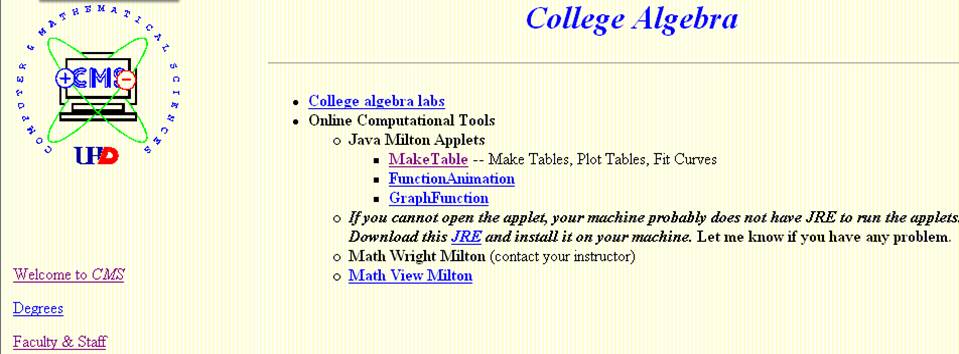
2. Select Make Table.
Rewrite the equation so that one side is zero; then take the nonzero side of this new equation as the formula for the associated function f(x).
What is the relationship between the original equation and the associated function?
The solutions to the equation are the same as the root inputs of the associated function.
Enter the function formula on page 3-6 into the box following the label “f(x)” as follows.
[You can only use the variable x, multiplications must be explicitly entered using *, and exponents are indicated
by separating the base and exponent by the symbol ^ , Shift + 6.]
2*x^5-3*x^4+x^3-5*x^2-x+3
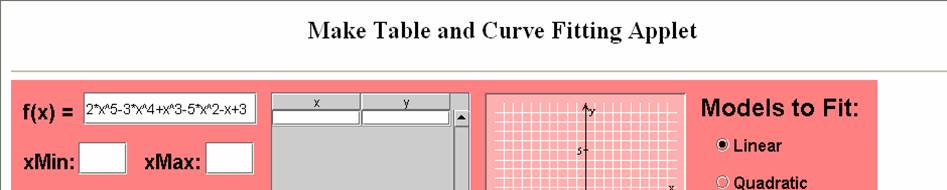
3. For the first table, different persons may choose different table domains. A popular choice is to use {-10, -9, -8, …, 8, 9, 10}as the domain for the first table. That is, the first table has xMin = -10, xMax = 10 and Number Points = 11.
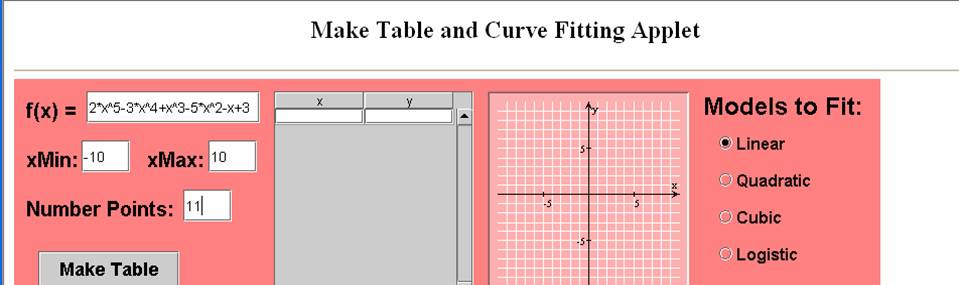
Finally, to have the computer make the table, just select (click on) Make Table.
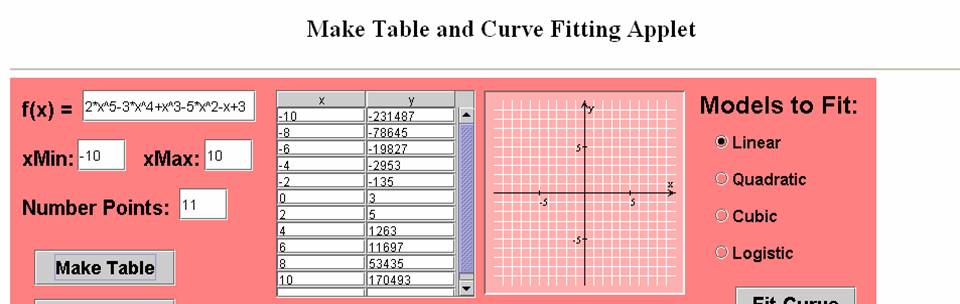
Table 1
4. Closely inspect the y (output) column in Table 1 constructed in step 3. We see that there are consecutive outputs (-135 and 3) that differ in sign. This is a signal that there is a root input (solution) between the two matching inputs -2 and 0.
-2 < root input < 0
5. To zoom-in to greater accuracy on this root input (solution), make another table by entering xMin = -2, xMax = 0 and then select Make Table.
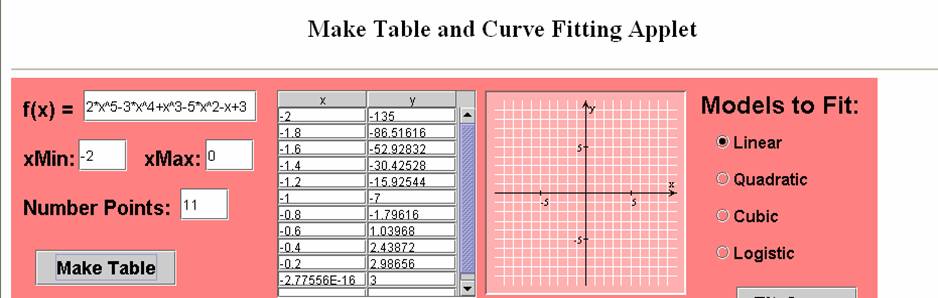
Table 2
5. Close inspection of Table 2, shows a change of sign in consecutive outputs from -1.79616 to 1.03988. This means there is a root input between the matching consecutive inputs.
-0.8 < root input < -0.6
6. To estimate the root input to two decimals of accuracy, continue to make tables until the root input lies between two numbers that have exactly the same digits through the second decimal.
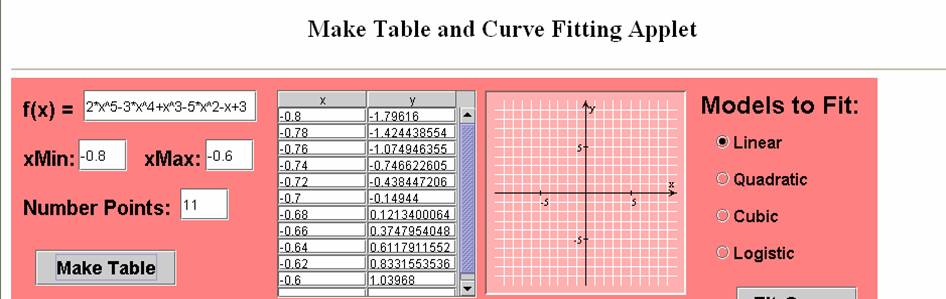
Table 3
-0.7 < root input < -0.68
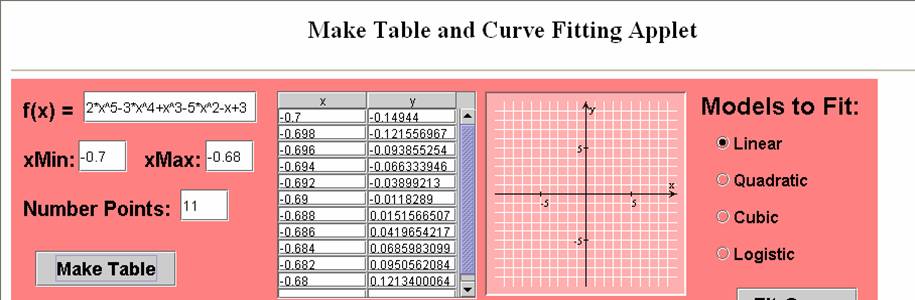
Table 4
-0.69 < root input < -0.688
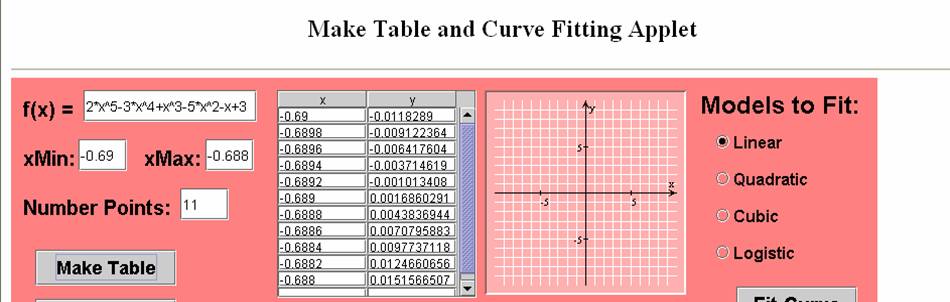
Table 5
-0.6892 < root input < -0.689
Since the root input lies between two numbers that are exactly the same through the second decimal, we have an approximation for the solution to the equation. The solution is accurate to two decimals.
|
x ≈ - 0.68 |